


+919168097864

DRSUSHRUTSAWARKAR https://www.criticalcareclasses.in
Preview

This is your website preview.

Currently it only shows your basic business info. Start adding relevant business details such as description, images and products or services to gain your customers attention by using Boost 360 android app / iOS App / web portal.

919168097864

Services

Intensive Care & Critical Care Medicine (ICCM) – Key ConceptsIntensive Care and Critical Care Medicine (ICCM) focuses on the management of life-threatening conditions in critically ill patients, often in an ICU setting. Below is a structured breakdown of core topics in ICCM.1. Core Principles of Critical CareA. Hemodynamic Monitoring & Shock ManagementTypes of Shock:Hypovolemic (hemorrhage, dehydration) → Fluids, blood transfusion.Cardiogenic (MI, HF) → Inotropes (dobutamine), vasopressors (norepinephrine).Distributive (septic, anaphylactic) → Fluids, norepinephrine, epinephrine.Obstructive (PE, tamponade) → Thrombolysis, pericardiocentesis.Monitoring Tools:Invasive BP (arterial line), CVP, PAC (pulmonary artery catheter).Echocardiography (assess cardiac function).B. Respiratory Critical CareAcute Respiratory Failure:ARDS (low tidal volume ventilation, prone positioning).COPD exacerbation (NIV, steroids, bronchodilators).Mechanical Ventilation:Modes:ACV (Assist-Control Ventilation).PSV (Pressure Support Ventilation).PCV (Pressure Control Ventilation).Weaning: Spontaneous breathing trials (SBT).C. Neurological Critical CareComa & Altered Mental Status:Glasgow Coma Scale (GCS).Causes: Stroke, seizures, metabolic (hypoglycemia, hepatic encephalopathy).Status Epilepticus:Benzodiazepines (1st-line) → Lorazepam IV.Second-line: Levetiracetam, valproate, propofol.Increased ICP:Mannitol, hypertonic saline, sedation, decompressive craniectomy.D. Renal & Metabolic Critical CareAcute Kidney Injury (AKI):RRT (CRRT vs. intermittent HD).Electrolyte Emergencies:Hyperkalemia (calcium gluconate, insulin/glucose, dialysis).Hyponatremia (slow correction to avoid osmotic demyelination).2. ICU-Specific SyndromesA. Sepsis & Septic ShockManagement:Fluids (30 mL/kg crystalloid).Vasopressors (norepinephrine).Antibiotics within 1 hour.Source control (drainage, debridement).B. Multiorgan Dysfunction Syndrome (MODS)Progressive failure of ≥2 organ systems (e.g., lungs, kidneys, liver).Treatment: Supportive care, treat underlying cause.C. Delirium in ICUCAM-ICU (diagnostic tool).Management:Non-pharmacologic (reorientation, sleep hygiene).Pharmacologic (haloperidol, dexmedetomidine).3. Advanced ICU InterventionsA. Extracorporeal Membrane Oxygenation (ECMO)Types:VV-ECMO (respiratory failure).VA-ECMO (cardiac + respiratory failure).Indications:Severe ARDS (PaO₂/FiO₂ <80 despite optimal care).Refractory cardiogenic shock.B. Therapeutic Hypothermia (TTM)Post-cardiac arrest (target 32–36°C for 24 hrs).C. Tracheostomy in ICUIndications: Prolonged mechanical ventilation (>7–10 days).

Sawarkar Multispecialty Hospital, Above Khadi Gramodyog Bhawan, Tilak Putla, Gandhisagar, Mahal, Nagpur

Acute Respiratory Distress Syndrome (ARDS) – ManagementARDS is a life-threatening form of respiratory failure characterized by diffuse alveolar damage, non-cardiogenic pulmonary edema, and severe hypoxemia. It is classified by the Berlin Definition based on severity.

Sawarkar Multispecialty Hospital, Above Khadi Gramodyog Bhawan, Tilak Putla, Gandhisagar, Mahal, Nagpur

epsis and Septic Shock ManagementSepsis is a life-threatening organ dysfunction caused by a dysregulated host response to infection, while septic shock is sepsis with persistent hypotension requiring vasopressors and a lactate >2 mmol/L despite adequate fluid resuscitation.1. Immediate Management (First Hour – 'Golden Hour')A. Initial Resuscitation (Sepsis-6 Bundle)Oxygen – High-flow O₂ if hypoxic (target SpO₂ ≥94%).Blood cultures – Before antibiotics (but do not delay treatment).Broad-spectrum antibiotics – Within 1 hour of recognition (see below).IV fluid bolus – 30 mL/kg crystalloid (e.g., normal saline or balanced solutions like Ringer’s lactate).Lactate measurement – If >2 mmol/L, indicates tissue hypoperfusion.Vasopressors if refractory hypotension – Norepinephrine (1st-line) if MAP <65 mmHg after fluids.B. Hemodynamic SupportFluids:Crystalloids (avoid hydroxyethyl starch).Monitor for fluid overload (e.g., crackles, JVP↑).Vasopressors:1st-line: Norepinephrine (α-agonist → vasoconstriction).2nd-line: Vasopressin (if refractory shock).Epinephrine (if extremely unstable).Inotropes (if low cardiac output):Dobutamine (if poor ejection fraction).3. Adjunctive TherapiesA. CorticosteroidsHydrocortisone 50 mg IV q6h (if refractory shock despite fluids + vasopressors).Consider ACTH stimulation test (but do not delay steroids if shock is severe).B. Blood Glucose ControlTarget: 140–180 mg/dL (avoid severe hypoglycemia).C. Venous Thromboembolism (VTE) ProphylaxisLMWH (e.g., enoxaparin) or heparin SC.D. Stress Ulcer ProphylaxisPPI (e.g., pantoprazole) or H2 blocker (if high bleeding risk).4. Monitoring & Supportive CareA. Hemodynamic MonitoringArterial line (for continuous BP monitoring).Central venous catheter (for vasopressors, CVP monitoring).Echocardiography (assess cardiac function).B. Respiratory SupportMechanical ventilation if ARDS develops (use low tidal volume ~6 mL/kg).C. Renal SupportCRRT (Continuous RRT) if AKI with fluid overload/refractory acidosis.5. Prognostic Markers & ComplicationsPoor prognosis:Lactate >4 mmol/L, persistent hypotension, multiorgan failure.Complications:ARDS, DIC, AKI, adrenal insufficiency, critical illness neuropathy.

Sawarkar Multispecialty Hospital, Above Khadi Gramodyog Bhawan, Tilak Putla, Gandhisagar, Mahal, Nagpur

Meet Our Doctor

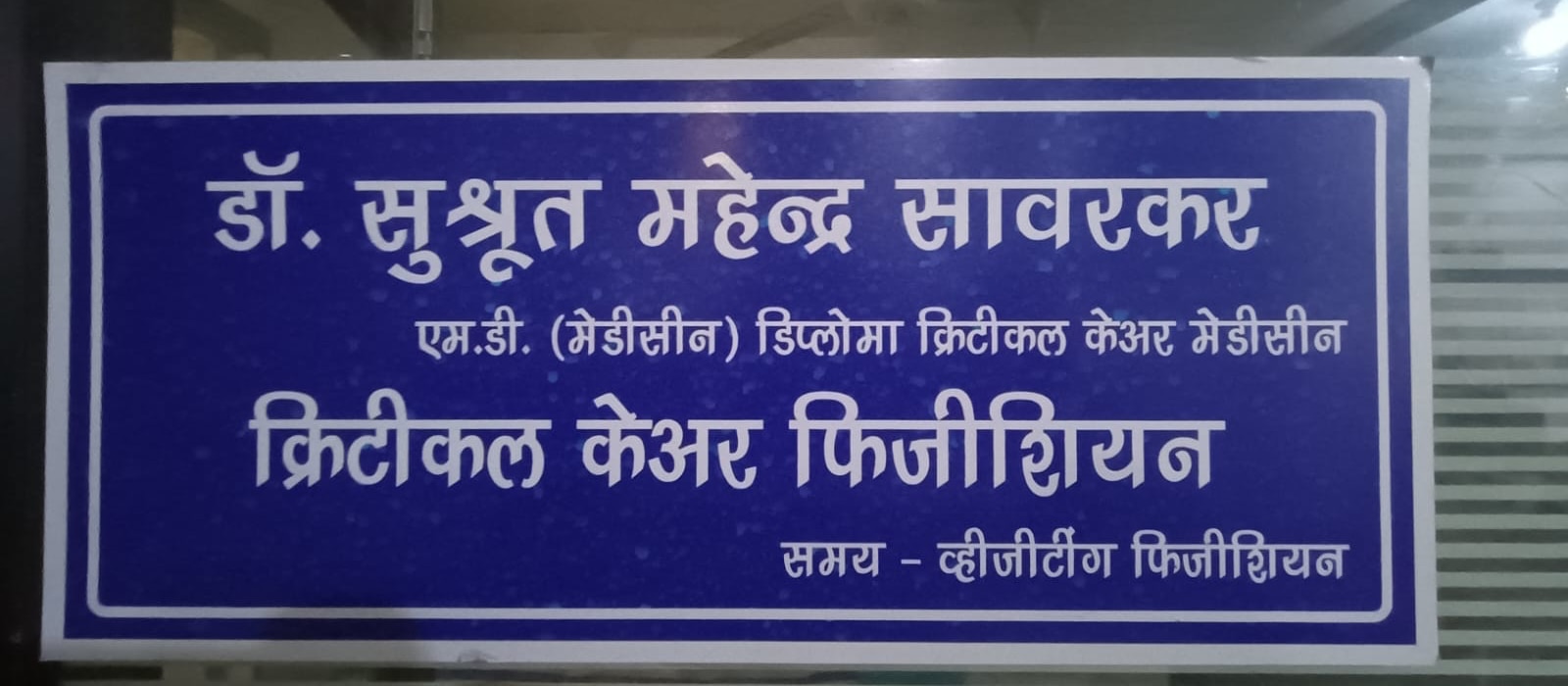
DR. SUSHRUT M SAWARKAR

DR. SUSHRUT M SAWARKAR

Consultant Critical Care Physician & Cardiologist. Also Having Expertise in Heart Failure, Morbid Obesity & Metabolic Syndrome, Diabetes and Its Preventions, etc

Phone +91-9168097864

Ex Consultant At Wockhardt Hospital, Nagpur. Ex Consultant at ESIS Hospital (Somwarpeth, Nagpur). Ex consultant at Rahate Surgical Hospital, CA Road, Nagpur. Currently Working In Lata Mangeshkar Hospital Sitaburdi As Head Of Department Of Critical Care Medicine And Also Catering Services In Medicine OPD. Special Interest In Improving Quality Of Life Of Patient Who Is Suffering From Heart Failure, Morbid Obesity & Metabolic Syndrome, Diabetes and Its Preventions.

Sawarkar Multispecialty Hospital, Above Khadi Gramodyog Bhawan, Tilak Putla, Gandhisagar, Mahal, Nagpur

Testimonials

Best critical care physician In nagpur.*****

Patient Testimonial

Dr. Sushrut is a great. He listens to the patient really calmly and talks very politely. He explains all the details nicely and even clears all the doubts in patents mind. 😄*****

Patient Testimonial

Latest Update

Salient Features of our Critical Care Medicine ...

It's Done!!

Your appointment is confirmed

Doctor Name:

Date & Time:

Contact:

Address: Sawarkar Multispecialty Hospital, Above Khadi Gramodyog Bhawan, Tilak Putla, Gandhisagar, Mahal, Nagpur

Appointment details has also been shared with you on your mobile number . Please arrive atleast ten minnutes ahead of the scheduled time.

services